
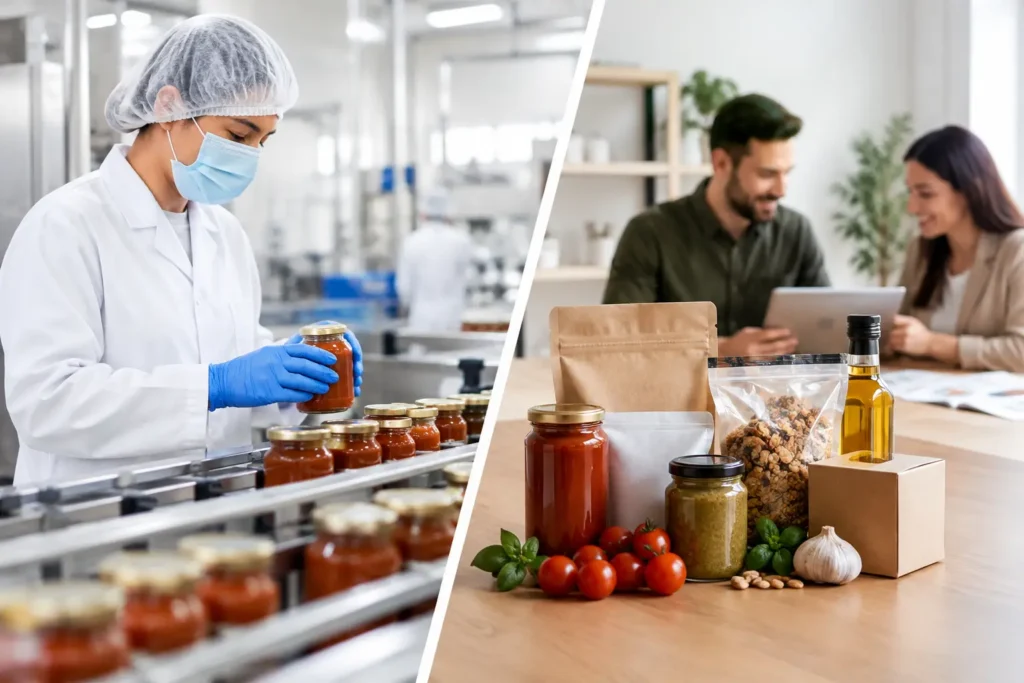
A great banana snack idea can become a retail product quickly – or get stuck for months in recipe testing, packaging revisions and production planning. The OEM versus ODM decision shapes that journey. For entrepreneurs, retailers, hotel owners, chefs and distributors, the right manufacturing route determines how much control you hold, how quickly you can launch and how much capital you need before the first carton leaves the factory.
There is no single winner. OEM may suit a business with a clear product vision and an established recipe. ODM can be the smarter move when you want a market-ready frozen food or snack range without building every detail from zero. The key is choosing a model that matches your commercial goal, not simply picking the option that sounds more customised.
OEM versus ODM: the practical difference
OEM means Original Equipment Manufacturer. In food manufacturing, this usually means you bring the product concept, recipe, specifications or brand requirements, and the manufacturer produces it for you. The finished product carries your brand, while the factory provides production expertise, machinery, ingredient sourcing support and quality controls.
For example, you may have a signature cekodok pisang recipe, a preferred banana variety, a specific sweetness level and a clear idea for retail packaging. An OEM partner can help turn those requirements into a consistent frozen banana ball product made at commercial scale.
ODM means Original Design Manufacturer. Here, the manufacturer already has a developed product or product platform and helps you adapt it for your brand. You may select from existing formats, flavours, pack sizes or packaging options, then launch under your own label. The core product development work has largely been done before you arrive.
Think of an entrepreneur who wants to sell banana chips in a spicy Korean-style flavour, sweet cinnamon, or salty pepper profile. With ODM, they can begin with an existing, proven snack base rather than spending months developing slicing methods, frying parameters, seasoning adhesion and shelf-life performance.
The distinction matters because OEM is led by your specification, while ODM is led by the manufacturer’s existing capability. Both can result in a product with your logo on the pack. What changes is the route to market.
When OEM is the stronger choice
OEM works best when your product idea is the heart of your brand. Perhaps you are a chef with a recognisable flavour profile, a retailer with a strong customer insight, or a food business expanding a popular menu item into frozen retail packs. You want something that is clearly yours, not merely a different label on a familiar product.
This route gives you greater influence over ingredients, texture, portion size, flavour direction and product positioning. For frozen foods, that could mean deciding whether banana fritters should be crispier after air frying, whether banana rolls need a particular filling ratio, or whether banana doughnuts should suit a café dessert menu as well as home preparation.
OEM also makes sense when your customers have specific requirements. Hotels and caterers may need larger foodservice packs. A premium grocery buyer may require a particular nutritional positioning. An export customer may need ingredients, labelling and carton formats suited to its destination market. These details can be built into the manufacturing brief from the start.
However, more control usually requires more preparation. You need to provide clear direction, approve samples, allow time for trials and be ready to make decisions when a recipe behaves differently at factory scale. A flavour that works in a small kitchen may need adjustment when produced in larger batches. That is not a failure – it is part of commercial food development.
OEM can also involve higher initial costs and minimum order quantities, especially where special ingredients, unique packaging materials or dedicated production settings are required. It is often the right long-term route, but it is not always the fastest first route.
Questions to settle before starting OEM
Before approaching an OEM manufacturer, be clear about what is fixed and what is flexible. Is the recipe non-negotiable, or are you open to technical improvements? Do you own the brand and artwork? What retail price must the product achieve? Will it be sold frozen, shelf-stable or through foodservice channels?
You should also decide what makes the product commercially distinct. “Banana chips” is a category. “Thin-cut banana chips with a bold chicken spicy seasoning in a resealable sharing pack” is a product direction. The clearer the brief, the more useful and accurate your manufacturer’s response will be.
When ODM helps you launch faster
ODM is built for speed, practicality and lower development risk. It is especially useful for new business owners, distributors entering a new category, or retailers that want to test demand before investing deeply in custom development.
Instead of beginning with a blank page, you begin with products that have already been designed for production. You may choose an existing frozen banana range, adapt the branding, select a pack size and confirm the required order quantity. This can shorten the time between idea and launch considerably.
For a kiosk operator, ODM may offer a direct path to adding familiar Malaysian favourites such as jemput pisang, banana fries or banana rolls to a menu. For an importer, it can provide a faster way to introduce Malaysian banana delicacies into overseas retail or foodservice channels. For a supermarket buyer, it offers a more straightforward private-label opportunity where the product format is already proven.
The trade-off is exclusivity. If the factory’s base product is available to more than one client, your brand must stand out through its identity, packaging, target market, flavour selection, service model or distribution strength. A strong label alone is not enough. You need a clear reason for customers to choose your pack from the shelf or freezer.
ODM is not necessarily a lesser option. A well-developed product platform can be a commercial advantage. It allows you to focus your resources on sales, market entry, retailer relationships and repeat orders instead of spending all your budget on early-stage development.
Cost, control and speed: choose your priority
The most useful way to compare OEM and ODM is not to ask which model is better. Ask which priority matters most at this stage of your business.
If control over the final product is your main priority, OEM usually gives you more room to shape the outcome. If launch speed matters most, ODM normally has the advantage. If you are testing a category with limited starting capital, ODM may reduce the risk of committing to an unproven formula. If you already have a strong concept and customers waiting for it, OEM can protect the character of what you are building.
Your expected order volume matters too. A manufacturer needs efficient production runs, practical ingredient purchasing and safe storage planning. Small trial orders can be valuable, but not every fully customised product is viable at very low volumes. Be open about your forecast. A good manufacturing partner should help you identify a realistic route, whether that means beginning with an ODM range or planning OEM development around a larger launch.
Branding is more than putting a logo on the pack
Whether you choose OEM or ODM, private label success depends on commercial clarity. Your packaging should tell buyers what the product is, how to prepare it, who it is for and why it deserves space in their basket. This is particularly important for Malaysian foods entering new markets, where terms such as cekodok or jemput pisang may be unfamiliar to some customers.
Use the local name with a helpful description. For example, “Cekodok Pisang – Malaysian Banana Balls” gives the product cultural identity while making it accessible to first-time buyers. The same principle applies to flavour. Be bold, but be clear about heat level, serving ideas and preparation instructions.
For frozen ranges, consider how the product performs in an air fryer, oven or deep fryer, as well as how clearly the pack communicates preparation time. For snacks, focus on crunch, flavour recognition, portion format and shelf presence. A retailer is not only buying a product – they are buying a product that can move.
Choosing a food manufacturing partner
The best partner is not simply the factory with the lowest quoted price. Look for a manufacturer that understands your route to market and can discuss practical matters early: product category, packaging, lead times, minimum orders, storage, delivery arrangements and market requirements.
Ask to see samples and discuss how consistency is managed from batch to batch. Clarify which party is responsible for artwork, packaging procurement, product specifications and approvals. If you intend to export, raise that at the beginning, not after the pack design is complete. Export-ready planning may affect labelling, carton configuration and documentation.
For brands built around banana foods, working with a specialist can make a meaningful difference. Pisango brings experience across frozen banana favourites, flavoured banana chips, packaging and private-label development, with the practical perspective of a business that also sells through kiosks and commercial channels.
Your first manufacturing decision does not need to define your business forever. Many growing brands start with ODM to enter the market quickly, learn what customers buy and build cash flow. Later, they move into OEM when they have a clearer winning flavour, stronger volumes and a product concept worth developing further. Start with the route that helps you sell confidently, then let real customer demand guide the next batch.